It is time to learn more about social responsibility in sports and more specifically in football. The tenth annual ranking of international football leagues’ environmental, social and governance commitments, RESPONSIBALL helps us explore and learn more about the work outside of the pitch. In this report you will be able to explore: how the different football leagues are ranked according to the topics; Governance; Community; Environment. Additional key issues are also included in the report: Racism, anti-Semitism, homophobia and other discrimination in football; Domestic violence; Refugees and migrants; Women’s football. Lastly, the report also shares some good practices from each topic. In this article we will share some highlights from this report and you will learn who tops the ranking.
About RESPONSIBALL
RESPONSIBALL is the first point of reference for responsible football clubs. It supports the progress of social responsibility at all football clubs.
Funded by the work of SchweryCade, RESPONSIBALL provides an online platform for a community of practitioners within the football sector to act together and promote and maintain high standards of meaningful social responsibility.
RESPONSIBALL has two key goals at the heart of its mission:
• To showcase good practices in governance, community development, and environmental stewardship;
• To support a community of practitioners
About the 2020 RESPONSIBALL RANKING
AUTHOR
RESEARCHERS
Lili Borisova, Kenneth Cortsen, Juan Manuel Ferrer, Sung Jung, Jean Lee, Nina Lunkina, Alex Matsuo, Oscar Manuel Palma, Ilias Petrogiannis, Manas Rastogi, Mia Salvemini, Marisa Schlenker, Taizo Uchida, Graziella Widmer, Jakob Wikenstål.
Contact
info@schwerycade.com
Twitter: @Responsiball
Facebook: facebook.com/Responsiball
LinkedIn: Group – Responsiball
Instagram: @Responsiball_org
The ranking 2020
The purpose of the annual RESPONSIBALL Ranking is to raise awareness and demonstrate the level of social responsibility in elite level professional football, looking specifically at governance, community and environmental aspects of a club’s activities and commitments. This season saw an increase in all aspects of the research scoring, with the German Bundesliga ultimately being crowned the top of the 2020 RESPONSIBALL ranking. Their efforts in community and environmental work, in particular, pushed them ahead of the 19 other leagues that were studied this season.
This season, an extraordinary one marked by a latter half filled with disruptions, delays and a constant redevelopment of the idea of what could or could not be done, was not solely defined by the Covid-19 pandemic. The first half of the 2019/2020 season, which for most leagues began in August or September of 2019, was business as usual; it was not until March of 2020 that the global pandemic changed the face of football for the remainder of the year.
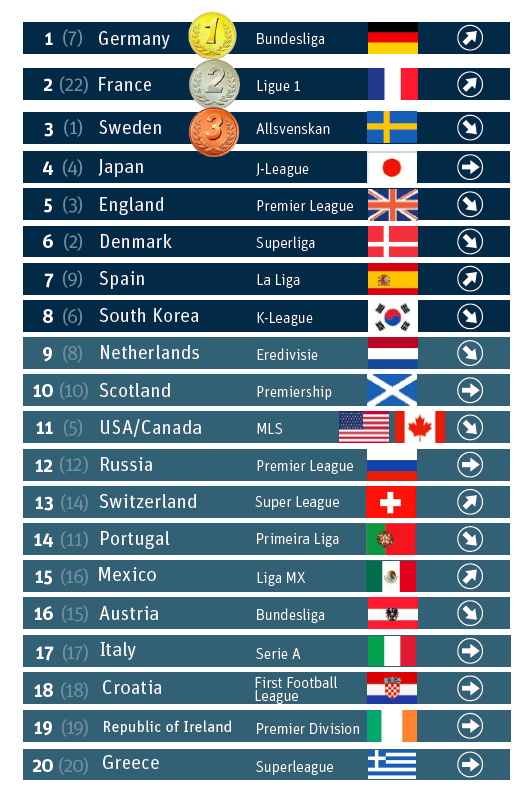
Scores for some leagues did improve, though they may have decreased in their ranking position.
Governance
This season, 35% percent of the 320 clubs researched have at least one female representative on the superior decisionmaking body (board) at the club. Sweden led the charge with female representatives at 14 of their 16 clubs.
“Corporate social responsibility is a hard-edged business decision. Not because it is a nice thing to do or because people are forcing us to do it… because it is good for our business.”
Niall Fitzgerald, Former CEO, Unilever
Community
30% percent of the 320 clubs researched provide the contact information of a Disability Access Officer. Of the 20 English Premier League clubs researched this season, all 20 clubs provided contact information for a Disability Access Officer (DAO); no other leagues had 100%, though 16 of 18 German clubs and 14 of 18 Japanese clubs also provided contact information.
“No man is an island, entire of itself; every man is a piece of the continent, a part of the main. If a clod be washed away by the sea, Europe is the less, as well as if a promontory were, as well as if a manor of thy friend‘s or of thine own were: any man‘s death diminishes me, because I am involved in mankind, and therefore never send to know for whom the bells tolls; it tolls for thee.”
John Donne
Environment
Of the 320 clubs researched this season, 8% of clubs play in stadiums which achieved an environmental certification. The majority of those stadiums, 42%, are from the German Bundesliga.
“Thousands of tired, nerve-shaken, overcivilised people are beginning to find out that going to the mountains is going home; that wildness is a necessity.”
John Muir
Additional Key Issues
Each year, we discuss the three key topics governance, community and environment within the RESPONSIBALL ranking, these focused on 46 particular indicators that were chosen to represent universal commitments and activities that make the basis of a socially responsible club.
In this edition, we would like to offer a broader perspective, looking at some of the key issues that are not within the indicators, but that have stood out to us, both as football fans and sustainability professionals. The issues we have chosen to highlight do not represent all of the issues within football that are possible to discuss; we chose these because of their particular global relevance.
Want to learn more about these additional Key Issues, head over to the report.
Good Practices
In the last section around good practices you can learn more about governance from FC Schalke O4 (Bundesliga – Germany), Getafe CF (La Liga – Spain), St. Mirren (Scottish Premier League) and NAC Breda (Eredivisie – Netherlands).
When it comes about good practices within community you can learn more from FC Lugano (Swiss Football League), Ulsan Hyundai (K League 1 – South Korea), AC Milan (Serie A – Italy) and Aalborg BK (Danish Superliga).
Lastly there are some good practices around environment from New York Red Bulls (Major League Soccer – USA/Canada), Club Necaxa (LigaMX – Mexico), Gamba Osaka (J League – Japan) and St. Pölten (Tipico Bundesliga – Austria).
Want to learn more about these additional Good Practices, head over to the report.
Download the RESPONSIBALL RANKING 2020
This article is just highlighting the tenth annual ranking of international football leagues’ environmental, social and governance commitments, RESPONSIBALL. When reading this you should have been able to have some understanding about the work outside of the football pitch. In this report we have briefly explored: how the different football leagues are ranked according to the topics; Governance; Community; Environment.
If you want to learn more about the full report, make sure to head over to the report here.
Additional reading
If you enjoyed this article and want to learn more how to work within the social sphere in sports then you should definitely learn and adapt to the Convention on the rights of the child in sports.