
Why is passion important working in sport?

people expressing passion for a career in sports

Do you want to work in the sports industry? Do you love sports? Don’t just say that you love sports and think that you can work in the sports industry. You have to think deeper and identify your values, which can get you closer to your dream job. In this article, we will share why passion is important in order to work in the sports industry and also share three reasons why people want to work in the sports industry and what their passion is.

Values are your toolbox to your passion

At Sportidealisten we believe that working with a passion makes you work in a sustainable way. With this, we mean that you want to work at that job forever and that you hopefully will not feel tired and forced to go to work. Working for a long time will be and feel better if it is something you are interested in. One great example to understand and identify your passion is to think about what values you align with. At Sportidealisten, we strongly believe in values like Transparency, Innovative Mindset, Open-Minded, Trust, Inspiration and Loyalty.

We know how much it would mean to work with your passion, sports and we know the importance to support and work together. Our mission is to help you reach your own goal in the sports sector.

Why do people want to work with their passion, sports?

This is the very first start of our new mini-series of learning more about why people have a passion for working in sports and what makes them tick. From a project that was developed from the Covid-19 outbreak, we started to gather likeminded people that align with Sportidealisten’s values and drive.

In this first article you will learn why:

  • giving help and joy is a passion
  • sharing the best benefits of sports is a passion and,
  • it is easier to work if you have a passion for the work

Gratification as a passion

Shrey Upadhyay sharing his motivation to work in the sports industry.

“Your work is going to fill a large part of your life, and the only way to be truly satisfied is to do what you believe is great work. And the only way to do great work is to love what you do.” – sorry to repeat it again! However, this ‘overused’ quote by Steve Jobs explains the best why I want to get involved in the sports industry.

My biggest motivation to work in a sports organization is the gratification of my soul with my utmost passion. I always had a desire to live a fulfilling life comprising of fun, joy, thrill, drama, challenges, and love. I want to live in a place where I can share my views and thoughts freely. A place where the people have the same interests as mine. An office where staff discusses new ideas, the match that happened last night, a workspace that has more friends and fewer colleagues.

I have always loved sports because it brings people together irrespective of their nationality, language, ethnicity, color, and any other means of discrimination. It fills people with joy and provides them a reason to live. Most importantly, through sports one could achieve the penultimate human satisfaction by improving the lives of others and making them happy. Fortunately, I have found myself the “work” that I love. It is only a matter of time until I find the right opportunity. Till then, can you suggest me a more satisfying life?

— Shrey

Shrey Upadhyay, MSc Business Management in Sport

PS. He is looking for opportunities in Media, Marketing, and Business Development (exclusively in the sports industry). Let us know if you want to connect with Shrey.

Get in toucH with Sportidealisten

Physical activity is a free tool to bring well-being

Xiangyi Liu sharing his motivation to work in the sports industry.

My passion for sports came from a story in high school. Physical activities are, in general, not encouraged much at schools in China. Without regular sports activity, I remembered that even I couldn’t reach the national standard’s test for 800 m running.

I once became overweight and struggled to get the perfect body for years until I entered the sports and fitness industry. I started to know why people were passionate about sports and their stories. After some time I finally chose to pursue my Master’s degree in Sports Industry Management at Em-lyon Business School. For me, sports can be life-changing. I am proud to be part of the field of sports and how sports can get people engaged and bring well-being to society.

— Xiangyi

Xiangyi LIU, Master’s degree in Sports Industry Management, Em-lyon Business School

PS. She is looking for opportunities in areas like Administration, Communication, Coordinator roles, Management, Marketing, Sales and Support (exclusively in the sports industry). Let us know if you want to connect with Xiangyi.

Get in toucH with Sportidealisten

From working on the pitch to around the pitch

Sanchit Bhat sharing his motivation to work in the sports industry.

I have played football for my school and college at the national level and have represented them in various tournaments. I always wanted to become a footballer but couldn’t do it because of the limited resources in my country, India.

That was when I thought of pursuing a career in sports after my college graduation because then I could still continue to work in the field that I liked the most. I believe that if you are passionate about something then it becomes easy to follow that thing and you can also progress in that with a smile on your face.

And, since I was once part of a team myself I would like to be directly associated with the playing team of a club as I know I will understand it better and that it would bring me closer to what I wanted to pursue.

— Sanchit

Sanchit Bhat, MBA in sports management, Real Madrid Graduate School

PS. He is looking for opportunities in areas like Administration and Management roles (exclusively in the sports industry). Let us know if you want to connect with Sanchit.

Sanchit Bhat sharing his motivation to work in the sports industry.

Get in toucH with Sportidealisten

3 reasons why passion is important for working in sport?

Thank you Shrey, Xiangy and Sanchit for sharing your reasons why you have a passion for sports and why you want to work in the sports industry. These are three unique stories and people and they are all three determined to share their passion and values in the sports industry.

If you liked this article, may want to read these:

3 ways to express passion for sports jobs

How to build a sustainable career in sports?

For employers and job seekers in the sports industry

Learn how to improve your networking with LinkedIn

LinkedIn logo representing professional networking platform

The quick guide to shaping up your networking skills with LinkedIn

Have you ever thought: “How do I find a job and why does everyone tell me to network and what does it mean?”. You are not the first one to think so. No matter how you find out about a job, we usually need to talk with someone, either to ask questions about the role or when we do the job interview. We are humans and we like to connect with each other in order to build trust and add value to each other. The secret of how to manage all of this is not a single answer. However, LinkedIn is a great platform to get you going and to shape up your networking skills and to increase your chances to get a job. In the following text, we will give you an introduction to the key elements of LinkedIn and how you can get noticed in this busy and crowded world.

What is LinkedIn and why do I need it?

LinkedIn is recognized as a professional networking and business platform. It was founded in 2002 but was officially launched in 2003. LinkedIn has more than 645 million users across more than 200 countries. Their mission and the reason why you need it is basically, great opportunities to connect with people from around the whole world and become more productive and successful.

Below are 7 steps on how you can get going with your networking. Let us start with step 1.

Step 1: Setting up a LinkedIn account

You can jump over this if you already have a LinkedIn account. But if you don’t have an account yet, start but creating one today. 40% of the monthly LinkedIn users access it on a daily basis. Despite this, you only have a few minutes to make an impact. Make sure you set up your profile today and then head over to step 2 and start to build attention so you can get noticed.


Step 2: A picture improves your chances to be found and connected

A lot of people on LinkedIn have a profile picture, but also a lot of people haven’t. Did you know that adding a picture increases your chances 14 times to be viewed by others?

At LinkedIn, the main focus is being professional, either connect with new potential clients, build your brand, find potential employers, and additional focus from a serious perspective. This makes it very important that you have a picture but also if you want to be viewed as a serious and trustworthy person that your picture is professional and serious. And please, don’t have a picture from a crazy party or a picture on your cat. To give you an example, here is our founder Jakob’s profile picture.

Professional headshot of Jakob Wikenstaal, founder of Sportidealisten.

Adding a picture increases your chances 14 times to be viewed by others

Lydia Abbot, Linkedin

Step 3: Your title is like your 8 seconds of attention

At LinkedIn, you have a short field called “Title” next to your profile picture, where you can add where you work or study. This is the place where it is very normal for people to decide if a person is interesting to look into more and head over to your profile. But it has also a great impact if someone would like to connect with you or not. And as mentioned in Step 1, the attention span is quite short, you need to be clear and interesting.

You might think: “but what if I don’t have a job and I am not studying?”. Well, don’t worry. Even people who have a job might not have their working title in this field. You might be looking into finding a new job and therefore you should be thinking about what job role you are searching for. Let us say you want to work with Sports Marketing. Then you could edit your title to:

Looking for a job in Sports Marketing

5+ experience in Sports Marketing, open to new opportunities


Step 4: Your personal summary, your CTA

Let us imagine you have caught someone’s (ours) attention and we clicked on your profile. We have seen your title and now we will have to scroll through your previous experiences (that you hopefully have added). This could be time-consuming and we might not read your profile as you would like us to do. But, hold on, there is a better way to get a quick sense of you, which is by reading a summary. Adding a summary at your profile could help the person who visits your profile page to learn a bit who you are as a person, what your values are, or what you have done and wants to work with. This section could actually help you getting the visitor’s attention and communicating whatever you would like the visitor to know about you.

Your summary is the text box at the top of your LinkedIn profile, just below your photo. It’s open-ended space (2,000 characters max) where you give an overview of your professional life. 

Guide: how to craft a great LinkedIn Summary

There are so many different recommendations about how to write the summary. We don’t have the only answer, but from our experiences, we have a good guide on how to start your own summary. Think about answering the following keywords: Mission, Key Skills, Highlights/Awards, Values, Vision, Previous Experiences, Discussion Topics. Here you can check out how our founder, Jakob have done.

  • Mission – What you can help a potential visitor, e.g. you are driven to help people make sales efficient
  • Key Skills – Describe your key skills, e.g. expert on Microsoft Excel and 5 years of customer care experience
  • Highlights/Awards – Any highlights/awards, e.g. Top 10 innovators according to ABC newspaper
  • Values – What values do you believe in and stand for, e.g. trust, transparency and positivity
  • Vision – Where do you want to go in your career? e.g. Striving to make the world in better physical and mental health.
  • Previous Experiences – Write a few sentences about where you have been doing in the past few years, not a long story, but briefly provide a short summary.
  • Discussion Topics – any topics you are interested to discuss and network around

Step 5: Adding your experiences

As we mentioned earlier, your profile should have your previous experiences, both academics, and work-related experiences if you have both. And it doesn’t matter if you have had paid jobs or been a volunteer. All experiences count. Add one after another, and make sure to add some brief story to each experience about what you did there and also something you accomplished. For example:

Sales at ABC – at Sales ABC I had several responsibilities around our memberships and I called current and potential clients to sell them a membership to the upcoming season. I also took part in our strategy meetings and provided several campaign plans that improved our revenue by 5 % two years in a row.


Step 6: Try to connect with your current network

Now when you have set up your LinkedIn profile and have a good and professional page it is time to build that network you always wanted. In order to make it easy, to begin with, we recommend you to start searching for your current network. It is always hard at the begging of who to connect with, but usually, LinkedIn helps you with a suggestion of whom to connect with. Try it out, but don’t feel the need to do this right now. Instead, think about your friends, your current and former colleagues and student colleagues. From this stage, you get a solid base, but make sure you want to connect with them because you feel that they can help you in the future with advice, networks or that you feel that you could help them with the same thing.

Don’t just connect with people to have a network, try to think if you can add value to them or if they can add value to you. As soon as you start sending requests to connect you will be recommended by LinkedIn to connect with similar people to the one you sent a contact request. Who knows, maybe you find your future employer, co-founder, colleague through this?

Well, try out LinkedIn, stay connected, and try to make a visit to LinkedIn as a daily habit. Good luck!


Step 7: Join us on LinkedIn

Now when you are ready to connect and network at LinkedIn we welcome you to join us on LinkedIn. Make sure you are not missing out anything from Sportidealisten. Click on the symbol below and follow us at LinkedIn!


If you liked this article, may want to read these:

How to use LinkedIn to find a job in sports

3 ways to express passion for sports jobs

How to create a great sports job application

How to build a sports job

Busy desktop with tools and graphs of how to build a sports job

Getting a job in the sports field is quite tough and competitive, so how should you do it? How do you find a dream job in sports? We have talked with Jessica Pettersson that found problems in sports and therefore created her dream job in sports instead of searching for it. Today she helps sports clubs that don’t have time for administrative work, which is more or less the majority of the sports clubs at least in the Nordics. In this interview, she will explain how she did to achieve her dream job in sports and she also provides advice on how you can create yours and lastly Jessica will give some tips on how to recruit in sports.

MEET THE SPORTS INDUSTRY FROM THE INSIDE

Jessica Pettersson – Founder and CEO at Föreningskraft
Education background: Public Health Sciences at Karolinska Institutet and Child and Youth Sciences at Stockholm University

What experiences can get you a sports job?

Hi Jessica and thank you for taking the time to share your experiences in the sports industry. Let us start by asking, who is Jessica?

I am a public health scientist combined with a master’s degree in Child and Youth sciences. After my studies I found myself in the volunteer sector and worked both at Friends as well as Min Stora Dag (My Special Day). To date I am the CEO of Föreningskraft, where we help sports clubs with administrative work, in areas which they themselves can’t do it, don’t have the time for or doesn’t want to do.

Now, let’s get further into sports. Why did you choose to go into sports and work in the sports field?

I have been involved in the sports field since my parents put me in gymnastics at the age of 4. I have then continued working in sports in different roles like an athlete, a coach, a board member, a referee and more.

Sport has given me so much and therefore I want to give back to the community in every way I possibly can. It is a big movement in Sweden and sport is where I have gained joy for a physical active lifestyle and knowledge about leadership.

WHY YOU SHOULD CREATE A CAREER IN THE SPORT INDUSTRY

sports job,sports,sports career,Föreningskraft,sports administration,create your own job in sports,sports industry,Jessica Pettersson,sports clubs,sports management,sports entrepreneurship

How did you come up with the company, Föreningskraft?

There are two reasons why I founded Föreningskraft.

I was part of creating a sports club several years ago, and it has steadily grown. However, the board had to work a lot with the operations making sure everything was working. The aim since the beginning has been to be able to hire one person full time. Today we have quite some time left in order to get a good economy and working tasks that are attractive to hire someone part or full time. Then the idea struck me; what if I, for example, worked 25 % in several clubs? Then I could build myself build an attractive work week.

The second reason was more about being more flexible with work hours and work spaces. In order to work in a sports club, you are not necessarily required to work in a physical sports office. A lot of work is today managed with your computer and your phone. By starting up Föreningskraft I also manage to be part of creating a modern work space, where when and where you work are decided by the employee himself or herself.

Right now, we are two people in the company and we are working with different sports clubs where the amount of work varies, from 10 to 50 % per sports club. In this way Föreningskraft has built a network with club officers, sports administrators and project managers, where we exchange experiences, competencies and helping each other. This becomes very valuable since many of the sports clubs only have one employee, which often makes the work quite lonely.

HOW TO GET A JOB IN SPORTS AND THE ROLE OF EDUCATION

You have been a student before and studied health. Can you describe and explain how your student experience was like and how that may have helped you achieve a career in the sports industry?

During my bachelor’s degree I got to know a little bit about everything. This was also the time when I gained an interest in evaluation and this has become a big help when several sports clubs are asking for help to evaluate their own clubs. The evaluations have been everything from surveys to interviews with parents, athletes, board members and coaches.

During my masters I learned how to think outside the box and approach different situations and challenges from different perspectives. This has been a crucial part of my career when I am working with sport clubs and their own club development and efficiency.

What steps did you take to close the gap from being a student to becoming a sport professional?

The first step was to start up my own sports club. Within that process I have learned many things about club development, how a sports club is being managed, what challenges comes along and how you can solve those. I have also further deepened my understanding about how a sports club is working and is structured. This is probably the main reason to why I today have the opportunity to work with several projects in different sports clubs.

What does a founder in sports do?

With your current role, what are your different tasks?

Since I am working with several sports clubs there are different challenges and tasks. To give an example, at one club I am managing and developing their website and guidelines. At another I am a project manager helping a club with different competitions and camps and in a third example I might work on coach development, invoices or efficiency within the organization. This variation gives me the joy working at Föreningskraft.

As the CEO of Föreningskraft my main responsibilities are HR, finance and marketing. I have the main responsibilities making sure customers as well as employees are satisfied and getting what they are promised.

Three important skills in THE SPORT INDUSTRY

What three skills are important to step into the sports field

Good questions! I believe in the following:

You need to be a person who is structured and can manage several tasks at the same time.

You should have gained some kind of volunteer experience. It is important to understand why people work for free and put in hours of work into the sports field without earning a single cent.

Lastly, you need a big passion for sports and the sports community. You don´t necessarily have to have any experience or passion for a specific sport, as long as you love sports in general. But knowing what’s required and understanding the bigger picture is key to bringing yourself and your surroundings into an engaged working place.

Do this if you would like to work in sports

What advice do you have for students or other inexperienced job seekers who would like to work in sports?

Create your own experiences! That is what I did when I built a sports club together with friends. By working with our own sports club I got to learn how to be a manager and as of today, I am a paid sport manager in a sports club, just to mention one of the roles I carry.

However, you don’t have to build your own sports club. You could also volunteer on bigger sporting events, or become a coach in sports. Another way to go could be to step into a committee in a sports club like the educational committee, where you can be part of the development in sports.

How to hire in sports?

Now, heading towards the end. You have recently hired your first colleague to Föreningskraft. Congratulations! Could you explain how you know that the time was now to hire? And how did you know who to hire?

For me it was all about timing. There was one job from a sports club that came in at the right time.

Föreningskraft has been up and running since the fall of 2017 and I have now become experienced with the job and I have achieved a good structure that suits me and the sports clubs. Together with a colleague, we can grow this company and reach the next level.

I received far more applications that I ever expected, which I am very happy about. Many of them were a good match for the job. And why I chose the one I have as a colleague today? Well I had done an analysis of the needs that the sports clubs had and I tried to match that with the applicants. I also considered the right applicant based on an engagement for the company, previous work experiences, education and personality.

Advice to hire in sports

At last, could you give other sports organizations your three best hiring advice?

Do the heavy work, build a job post that really match with what you are actually looking for.

Take a step back and look into your organization with an objective lens and ask yourself, what do the organization need right now? Then try to hire a person to fill that need.

Contact Föreningskraft and we will solve your sports club’s needs with the help of sharp administrators with a “doer” mentality.

If you liked this article, may want to read these:

How to build a sustainable career in sports?

For employers and job seekers in the sports industry

2 tips to find a job in sports

When you need to be adaptable

a person running with a surrounding that is changing in sports

2020 started at a normal pace and a lot of people were looking forward to excelling in their studies or their work in the sports field. However, from early March, the whole world slowed down and unfortunately, a lot of people was fired from their jobs. Not only that, but a lot of people were also forced to be in quarantine or at least work from home. How did we all handle this global change? Not even everyone can work from home. Denmark’s biggest football club made sure they prepared for situations like this. Let us look into what they have done and what you can do in order to be adaptable and not missing out in the future.

Sport clubs most valuable asset

2020 was a big challenge for all of us. Tons of meetings were canceled and with a sports perspective, a lot of Annual General Meetings (AGM) were forced to be postponed. But in times like the pandemic 2020, we realize that we needed to do everything together, now more than ever before but with a flexible approach. 2020 was the start of the time to be digital and adaptable.

AGM Voting Online - Image credit: Element 5 Digital
Image credit: Element 5 Digital

One sports club that was already prepared for the challenges of not running their General Assembly in a physical setup only was BK Skjold, Denmark’s biggest football club. Why? Well, they had already looked into and adapted a digital solution to voting online. In all these years, especially in Sweden, we have had quite challenging times when it comes to the AGMs. Despite the big football clubs’ big amount of supporters and members during the games, they are not showing up at the AGMs even though they have the right to vote and participate in the club’s operations. A normal amount of members on the AGMs for the biggest clubs could be about 250 when they have 5-10 000 members. For example, IFK Göteborg with an average of 12 000 attendance had 238 members with voting right at this year’s AGM.

And from a Nordic perspective, the AGM is the decision meeting where alla members can vote for decisions that can change the whole club´s future. To put it in other words, the biggest and most critical meeting of the year with a big impact by a club´s supporters.

Sure, there might be a lot of people who can’t make it for a specific date and time. But there are still a lot of people not showing up at the AGMs. But why haven’t most of us adapted ourselves like BK Skjold? With digital voting, more people can participate without the stress of time and place to be located.

BK Skjold, Denmark’s biggest club runs digital

BK Skjold, Denmark’s biggest football club - Image credit: BK Skjold
Image credit: BK Skjold

A few years ago BK Skjold presented a digital voting solution to their 1800 members. A digital solution called Assembly Voting that could help the club to enable more members to take part of decisions and vote online. The start of a digital transformation was from one AGM where they had 12 participating people at one physical meeting. They thought of a digital solution with the vision to share democracy to the whole club, which means all the members no matter where they lived.

How to grow a member-driven sports club?

The end result for BK Skjold and their online approach can be viewed below according to their President, Jens Sørensen:

  • 144 members voted that is more than 10 times as they usually get
  • They got 10 candidates to 4 board roles, which never happened before
  • They elected a qualified treasurer and an internal accountant – none of these positions have really been used for real during many years
  • 24 people came to the physical AGM – that is twice as the normal number
  • They received 15 motions through the digital solution
  • 9 of these 15 came from different members, which is another huge step for them.

What can digital voting do for sports clubs?

Thanks to digital solutions there are many great opportunities and reach is just one of them. From this story we can list several good benefits of digital voting in sports:

  • get more members to participate at AGM or other meeting points for members
  • makes it easy for members to be included and involved at different decisions
  • can create a bigger community and togetherness among the members
  • provides a greater variation among the suggestions about the club’s development
  • increases the input for the future of the sports club
  • gives members a greater insight into the club’s operations
  • builds transparency and trust about the club’s policy and decisions

Another thing that would be interesting to discuss is all the opportunities that arise with a digital voting system. Why not allowing the members to more often be part of the operations than once a year. As a member-owned club, you could and probably should involve the members more often than once a year. With the online voting system, you could run a voting process during one day or why not a week when you might want to decide if the club should create a special day for the fans or if the club should participate in the local community, etc.

Feel free to let us know what you would do or if you done this in your club.

If you liked this article, may want to read these:

How to become a successful and transformational leader

The modern leadership – how to be efficient

Leadership through sport management – How to be innovative

What a current sport management student needs to know

Sport management Student try to Discover essential tips and strategies for the sports management career to enhance the education and secure a career in the sports industry.

Tons of people start every year a sport management education in order to later work in sports, to get that dream job. There are also lots of unanswered questions or hidden tips of how you actually getting through your education and getting closer to that dream job in sports. Therefore, you will get some advice about what to know as a sport management student.

Networking breakfasts are both tasty and inspiring

In early February, our founder, Jakob Wikenstaal, had the honor to talk to current sport management students at his former sport management university, Malmo University. During the past decade, sport management program have built up a great tradition at the program where a few networking sessions are taken place throughout each year. This is usually a setup like a breakfast event (of course free breakfast, need to think about the students) where about three people from the sports industry come and talk about their work experiences and sometimes also ask for interns or other help.

In the past few years, these networking breakfasts have been developed into always inviting alumni to do one talk, in order to inspire what other graduates have been up to after the studies. Jakob have been invited a few times and he always felt proud being asked to do a talk and to have the opportunity to talk about his journey so far. It is always great to show that the future sport managers have a lot of opportunities ahead.

This is what sport management students should be aware of

What Jakob did talk about during this breakfast was about what sport management students should be aware planning ahead. Jakob always focusing on how far you can go by trying out new tasks and being curious to meet new people.

How to get a job in sports?

Many students in sport management enter their first days at the university and have a hard time understanding how and what they can do to get a job in sports. But that is nothing to be scared of. Jakob had the same challenges. It is hard to know what skills you have and what value you could add to your surroundings.

How Jakob made this trip? Well, he created his own path. Jakob has been (and always is) curious and asking questions to experienced people in the sports industry. He is also reading a lot of different books, news, and trends on the web. All of these sources gives him a lot of inspiration and knowledge. Make sure to have different perspectives with different sources, which gives you a critical and more creative and open mindset and this has also been a good benefit in his career.

Jakob Wikenstaal´s personal advice to find a job in sports:

  • When looking at jobs, one working title doesn’t say everything about what that job means and require and if you would like it
  • Ask people that already know
  • Go out and volunteer
  • Keep asking yourself if you do and have tried tasks that you enjoy

Be unique and have your own USP

When it comes down to your name and another candidate to get the job, you need to make sure the recruiter chooses you. How? Well, you need to be different. Be unique and make sure you show it. This will be your unique selling point, USP. Find out at least one thing that is your unique selling point, why YOU? In order to get there, here are four ways to become a bit better than your competitors:

  • Do more than your future colleagues/job seekers
  • Read a little bit more
  • Get to know one person more
  • Say yes to that extra task

If you liked this article, may want to read these:

How to build a sustainable career in sports?

3 ways to express passion for sports jobs

For employers and job seekers in the sports industry

How to implement the Convention on the Rights of the Child in sports

Children playing soccer, illustrating the implementation of the UN Convention on the Rights of the Child in sports.

Do you know about the United Nations Convention on the Rights of the Child (UNCRC)? In Sweden, this is the main topic in the sports movement. Since the start of 2020 this is a law in Sweden. We all need to rethink how we work in sports and how we treat our children.

The Swedish sports movement:

About 20 000 sports clubs

About 3 150 000 participants/members in sports clubs (the majority are in the age 6-14)

About 900 000 volunteers

The future sports generation

The Swedish sports movement is an important part of Swedish society. A lot of children growing up participating in a sport. This makes the sports movement an important part of raising our future, therefore the importance of treating our children with their rights is a big one.

Every year the youth sports clubs are getting funds from the government, however, this requires that the organisations are running from a child rights perspective. This is still something that hasn’t been managed enough and therefore the United Nations Convention on the Rights of the Child became law in Sweden 2020. This means that all the volunteers in sports and sports clubs need to raise the knowledge level about Children’s Rights in sports.

What is in the Convention?

The United Nations Convention on the Rights of the Child, or UNCRC, is the basis of all of Unicef’s work. It is the most complete statement of children’s rights ever produced and is the most widely-ratified international human rights treaty in history. You can read the full convention (pdf), or just a summary (pdf), to find out more about the rights that are included.

4 points to better understand youth sports

From a great lecture I experienced about this topic during 2019 I wanted to forward some important lessons to you. There are 54 articles that cover all aspects of a child’s life and set out the civil, political, economic, social and cultural rights that all children everywhere are entitled to. No matter who you are, where you are from, every child has rights. Important to know about the articles, no right is more important than another. However, the lecturer, Johan R Norberg, taught the audience four of these, because he thinks those can help the people who are involved within youth sports.

  • Article 2:
    • All children have the same rights and the same values.
  • Article 3:
    • It is the child’s best that should be a priority around anything where children are involved.
  • Article 6:
    • Each child has the right to survive and develop.
  • Article 12:
    • Children have the right to speak and be listened to.

What do these four articles mean and what can you do about them? Below are these further explained and in what situations they could be important to think about.

About the right to be involved, the same rights and values!

  • In areas with big houses and wealthy families, the sports clubs are doing good. The consequence, the less wealthy neighborhoods, and their local sports clubs are less developed and have fewer resources to include everyone.
  • How do we handle all sports that are splitting up the rules, like with ice hockey with ceratin rules for girls versus boys. Girls aren’t allowed to tackle.
  • What about para-sports? How can clubs and board members include more children in para-sports? Make sure to talk with your board and ask if they ever thought about including para-sports.

About the child’s best around anything where children are involved.

  • Sports aren’t made for children. From the beginning children aged 13-14 years old started to participate in sports. This could be one reason why we have to rethink youth sports.
  • If you think we can adapt the children to sports, think again. We have to adapt sports to children. League tables should be applied later because this reduces the stress on performance at an early age, which is one reason why many children quit sports early in their life.
  • Coaches are not all the same. Some learn by books, some by listening and some in other ways. We all need to rethink how to better teach and educate our surroundings in order to better treat children and taking decisions about children.

About each child’s right to survive and develop

  • How does it look with injuries in your sports club? Especially injuries at an early age. Will they be scarred for life and can’t practice any sport in the future?
  • Does any child in your sports club being bullied, discriminated in any way? Looks different, etc.

About the child’s right to speak and be listened to

  • For a lot of children, school and sports are very similar. They are both managed by adults and have fixed times. One consequence of this is that children get tired of school and thus they feel the same about sports.
  • What would happen if we could actually change this in sports and ask the children what they want to do and make it different than school?
  • Talk to children, because then you will know what they think! Maybe they want to play something that is far from your sport? Try it out.
  • Participation is one way to reduce the number of children that are quitting sports. The forecasts to stay are much better with participative processes. Try to propose different educations or activities. Just ask!
  • Do you have youth counseling groups? Or anyone under 25 years old at the board? Those are different ways of listening to youth.

Emergency plans if somethings happens or about to happen

You should develop an emergency plan! What can you and your sports organisation do if something happens, that shouldn’t happen? If a child gets hurt, who should you talk to? If an accident happens during a youth game, what should you do? There are several examples about this in the handbook below.

Handbook for how to work with the United Nations Convention on the Rights of the Child in sports

Thanks to a lot of different people, among these, the United Nations and two sports researchers, Johan R Norberg and Susanna Hedenborg, they have developed a great handbook for all of us. It contains summarized research and provides good overviews of how the convention could be interpreted in sports.

Furthermore, you can get good concrete tips on how to act and behave in your local sports club. For example, how to talk with children, how to involve them and understanding if they are worried.

Download the free book here or order it for free (in Swedish)

Three examples from Sweden

The following three sporting organisations, Brynäs IF, Marathongruppen and Svenska skidförbundet are involved with United Nations in different ways today and are working with the Rights of the Child in sports:

  • Brynäs and UNICEF collaborating with a project called A good start, with the aim to give more children a good start in life with education, healthcare, and different leisure activities.
     
  • Since 2018, the Marathongruppen arranging “Stafesten för UNICEF” at several places in Sweden. It is a running race that supports UNICEF’s work to help more children with a good start as possible in their lives.
     
  • The Swedish Ski Federation (Svenska Skidförbundet) are working together with Håll Sverige Rent (a non-profit organization that promotes recycling and combats litter through public awareness campaigns and environmental education) with the project, All children have rights. It is a project that helps children to have fun and play in the snow, no matter your background.

Lessons learned

The Swedish sports movement is an important part of Swedish society. We are raising our future, therefore the importance of treating our children with their rights is a big one. This is still something that hasn’t been managed enough and therefore the United Nations Convention on the Rights of the Child became law in Sweden 2020. This means that all the volunteers in sports and sports clubs need to raise the knowledge level about Children’s Rights in sports.

It is hard to remember all 54 articles about the Rights of the child. But start with these four points to better understand youth sports:

  • Article 2:
    • All children have the same rights and the same values.
  • Article 3:
    • It is the child’s best that should be a priority around anything where children are involved.
  • Article 6:
    • Each child has the right to survive and develop.
  • Article 12:
    • Children have the right to speak and be listened to.

There are many things to keep in mind. But most importantly, we need to rethink how we are treating our future generation in sports. We need to talk with the children, listen to them, how to involve them and understanding if they are worried. It starts with you and me, right here and now!


If you liked this article, may want to read these:

How to create a sport federation

The modern leadership – how to be efficient

Leadership through sport management – How to be innovative

How to become a Senior Research and Insights Executive in sports

Harriet Eastham, Senior Research and Insights Executive at Southampton Football Club, during an interview about her career in sports.

What does it take to work in sports and to work in the Premier League? It is time to share experiences and valuable tips from people in the sports industry. This month’s sports job spotlight is a person who started as a student and took the 1 % approach in order to find her dream job in sports.

Meet the sports industry from the inside

Harriet Eastham – Senior Research and Insights Executive at Southampton Football Club

Harriet Eastham - Senior Research and Insights Executive at Southampton Football Club

You got a new job in sports, congratulations!

Dear Harriet,

How are you doing? I am happy to connect with a person who is sharing a passion for sports.

You recently got a new job in sports, congratulations! As a person who runs a sports jobs platform with the mission to help more people finding their dream job in sports, I would be curious to ask you questions about your previous role in order to inspire more people finding their dream job in sports 🙂

Hi Jakob,
Thanks for your kind words! Happy to answer any questions you may have.

Ah, that is very kind of you. Let us get right into it.

First questions.

– Why did you decide to pursue a career in sports? 

– How did you get involved with Southampton FC?

I wanted to pursue a career in sport as it has a wonderful ability to bring people together. I knew that it was an industry that would be exciting, with no two days being the same, whether that was as a player or in the back office within the club. In regards to data analytics in sport, I knew I wanted to be apart of an innovative industry after being exposed to the work of Billy Bean and Bill James. It fascinated me how you could quantify elements of an industry that at times runs on emotion.

I was very fortunate that following my masters at Loughborough University London, there was a job opening in the Research and Insights department at Southampton FC. The job mirrored exactly what I had learned previously in modules on the course – so it was a dream come true! Fortunately, I grew up in Winchester just down the road from Southampton so I’ve always been a fan of the club and used to play as a kid for the girls’ team so it felt like a bit of a homecoming.

Many thanks for these answers, Harriet!

That sounds like a great story. And, you got back home 🙂

I certainly agree with no two days being the same!
So you did enjoy Loughborough then?

I loved my time at Loughborough and can’t speak highly enough of the place.

How to go from sport studies to a sports job?

How were your student experiences from Bachelor’s and Master’s and how did it help you to get a career in the sports industry? I mean, did Southampton FC only recruit you based on a Master?

And, what steps did you take to close the gap from being a student to working in the sports industry?

I’d say my masters definitely helped my chances of gaining a job in the sports industry. However, a lot of work outside of the classroom took place to make sure that I gave myself every opportunity to be exposed to the industry. I volunteered a lot at various sports events as a videographer, reporter and data analyst to make sure that I was getting in front of the right people to try and show that I was someone that they should take a chance on.

Happy to hear that Harriet. I had my guesses that you probably had done some extra work. At least according to me, I feel companies require something more than just an education.

And does Southampton FC engage and collaborate with any sport management/science university?

We have an academic partnership with Southampton Solent University currently 🙂

Okay. That is good. I guess most of the bigger clubs have some academic collaborations.


Also, have you heard about EASM?

I haven’t but I’ve started reading up on it and it looks great!

We will actually host our next Sport Management conference in London at your university, which will be mid-September 2020. So pretty close for you and maybe your colleagues and network. We (the EASM board) will actually visit Loughborough University London at the end of November 🙂 Looking forward to visiting it already!

I hope you enjoy your visit!
Yeah, I’m sure some of us would be interested in attending 😊

Thanks! I think you would like it. Do you also have any network and common events you go to among the premier league clubs?

There are certain Premier League forums that those higher up than myself attend, and we’ve started to see the likes of Facebook run Premier League only events for clubs to give them hints and tricks to getting the most out of their content on the site.

Aha. It sounds like exciting stuff ahead.

Advice on how to enter a new sports job

Last three questions that I am very interested to know from your perspective.

– What is your advice for other people just entering a new sports job?

Enjoy it! The sports industry can be a fast-paced place to work but that doesn’t mean that you should become overwhelmed and not enjoy the fact that you are hopefully working in a role or industry that you’ve always wanted to be in.

– What do you see as the top 3 necessary skills in order to break into the sports industry? It could be soft/business skills etc.

I’d say the business skills can be taught, but what can’t be taught is the soft skills of:

(1) Being tenacious – create your own opportunities if you have to. The sports industry is a competitive one to get into, so anything that can give you an extra boost to help you stand out is always a plus.

(2) Having an eye for details – Within sport, it’s all about the 1 percent for improvement in both performance roles and commercial roles.

(3) Being a sponge – Try and soak up all of the experience that others have around you and be willing to listen to what they have to say. Sometimes people can be quick to want to prove themselves, rather than respecting others’ opinions or experiences. I’m still learning every day from my colleagues, even those that may be younger than me as they bring something new to the business.

– What tips do you have for students trying to get a career in the sports industry?

Expose yourself to as many opportunities as possible and try and put yourself in front of people to grow a network. If you can show others your passion to work within the sports industry, then it becomes infectious and memorable so people are more likely to keep you around and recommend you to others. Also, as cliche, as it sounds, don’t give up!

Wow! I really enjoy reading these answers, Harriet. I highly appreciate you and your time to put down these meaningful words and thoughts. I can really align with being tenacious, the 1 % and being the sponge. I actually need to ask you one last question before we say over and out. How do you manage to stay up to date and adding that 1%?

I’m glad you enjoyed them – thanks for asking me! 🙂 

I spend the first 30 mins of my day at work having breakfast and reading outlets like SportsPro, Sports Techie and looking for opinion blogs on LinkedIn. I really enjoy learning from others and Ryan McCumber’s conferences (F.I.S.T and Sports Analytics World Series) are great resources to meet others and share ideas.

Thanks for sharing that too! You have certainly given a lot of energy and inspiration to the readers and to those that are looking into working in the sports industry and especially in the football industry. With that said I want to say, all the best of luck with your new job and I am looking forward to following your career in the world of sports!


If you liked this article, may want to read these:

How to build a sustainable career in sports?

For employers and job seekers in the sports industry

3 ways to express passion for sports jobs

Why EASM helps your sports career

Professional networking and development opportunities through the European Association for Sport Management (EASM) for sports industry professionals

Learnenjoy and never forget the experiences gained at EASM

That was the core message our founder Jakob got from his first experience from EASM. However, the initial question Jakob had 2014 when he first interacted with the European Association for Sport Management (EASM), was: what is EASM and what values can you get from them? 2019 was the year when Jakob could look back to these questions and give the answer you have been waiting for.

What is EASM?

Back in 2014, Jakob was about one year into his sport management studies. One of our professors mentioned a sport management summer school that was through an association called the European Association for Sport Management. Jakob and his student colleagues were told about this opportunity to go abroad, have several days of lessons and work with other future sport managers from around the world. As a future sport manager, Jakob thought this sounded like a great opportunity.

What was interesting at this stage? Well, it was an opportunity to add something extra, something of an international class to a CV and sport management career. Unfortunately, the dates and costs weren’t on a students side and Jakob never took that opportunity 2014.

EASM

Fast forward, 2017 was the year Jakob interacted with EASM again and this time he participated at the Student Seminar and the EASM conference in Switzerland. Jakob met more than 50 international students and they had five intensive but fun and valuable days at the Student Seminar. They learned a lot about the Olympic games and its history, but they also did the Management Game. The management game consist of group work around a challenge and the students need to solve this in a few days and deliver a great presentation.

Why EASM helps your sports career

Jakob´s group never won, however, they did a great job and most importantly they did their best. After this, the students moved to the EASM conference and the opening ceremony and this evening happened to be the next step in Jakobs´ career. He was honored and asked to be the successor as the Student Representative at the EASM board.

Why EASM helps your sports career

Lessons learned

Fast forward to the EASM conference 2019 in Spain, Jakob was ending his term as the Student Representative and then what? During the summer 2019 Jakob was thinking about the future. He asked himself: Why did I get the honor to be the Student Representative and what have I learned since then and what is EASM all about?

He wasnt sure where to begin. Jakob always asks around in social environments who and what brings people to act and what is their passion. This was what he did during the days of the Student Seminar too. Some people might call this networking and some might just call this curiosity. Furthermore, Jakob always try to listen and find new opportunities for his networks, trying to provide them feedback, ideas, etc. According to Jakob, if people do those things, they show passion and hunger to do more.

Taking on a board role in an international context was something Jakob never imagine being part of during his early days into his sport management career. Now years later, he can only say that he can recommend to try something similar to those who wants to make an impact on the international level and are looking for an international career. The people at the board of EASM have shown that everyone is welcomed. Even though Jakob was much younger or had less working experience than the rest of the board of EASM, Jakob was always free to ask questions, taking part in the discussions and the decisions. Furthermore, the board of EASM and the community is a community where you can take action. If you want to engage and make an impact you are welcome. The board volunteers their time. So, Jakob basically asked questions, what he could help out with and he proposed different action plans. Those things have allowed him to develop as a board member and as a person.

Why EASM helps your sports career

During these years, Jakob has since the start met and made new friends all over the world. He has talked and interacted with more than 240 students from the Bachelor to the Ph.D. level. Jakob has been part of the Local Organising Committee at the EASM conference 2018 in Malmo, Sweden, he has arranged two Student Seminars and one Summer School, and Jakob has developed an online platform for sport management students and developed a few Facebook groups where new EASM students can network. He continuously stayed connected and both kept contact with student participants online and offline. Jakob has also helped and managed the award committee for the Alberto Madella Scholarship Fund and helped develop an award for the Student Seminar 2019.

Basically together with great support from the EASM board members, Jakob has developed a sports management community for the rising stars within the field with the aim of increasing visibility of EASM within the Student community and engagement of European sport management students with EASM. When Jakob finished his term as the Student Representative, he thought through his experiences and chose to apply to become a full board member. What do you think happened? Jakob was chosen and then did additionally three years at the board of EASM.

What do you want to do with you career in the sport management field?

  • Are you working at a sport management related program/university and want your students to develop?
  • Are you a student who wants to develop and build your sport management network?
  • Do you want to contribute and further develop the sport management field with research, mentoring, working or if you have any ideas?

The European Association for Sport Management (EASM) offers significant advantages for professionals in the sports industry. Engaging with EASM can enhance your career through:

  • Networking Opportunities: Connect with a diverse group of international sports management professionals, academics, and students, facilitating the exchange of ideas and collaboration.
  • Professional Development: Participate in conferences, seminars, and workshops that provide insights into the latest trends and research in sports management.
  • Access to Resources: Gain entry to exclusive publications, research materials, and a comprehensive sport management library, supporting continuous learning and informed decision-making.
  • Career Advancement: Engage in mentoring services and collaborative projects that can open doors to new opportunities and enhance your professional trajectory.

Incorporating EASM into your professional journey can provide the tools and connections necessary to excel in the dynamic field of sports management.

Why EASM helps your sports career

If you liked this article, may want to read these:

How to build a sustainable career in sports?

For employers and job seekers in the sports industry

3 ways to express passion for sports jobs

The future of football will be like?

Future of Football Business Conference 2019 presentation

What is the future of football? What is the next big thing you should know about? How can football clubs and leagues adapt and stay innovative? A review of the Future of Football Business conference in Graz, Austria.

What is the Future of Football Business conference?

The Future of Football Business conference in Graz, Austria is the conference for digitization, innovation and future topics in the football business.

International experts provided insights into topics such as fan engagement, modern infrastructure, new monetisation possibilities, internationalisation, the use of data and many other hot topics in the football business.

Furthermore, experts from clubs and economy presented their best practices or learnings and discussed how to handle those changes and to use emerging opportunities. An additional focus was on startups from the football business ecosystem. Let us go through some of the insights.

Football startups and how they can help clubs

One of the many sessions during the conference was a panel discussion with the topic: How Clubs and Leagues can benefit from working with Startups. Involved in the panel were:

Tomasz Zahorski (Member of the Board, Legia Warsaw)
Patrick Lenhart (Head of Marketing & PR, Austrian Bundesliga)
Dirk Schluenz (Head of Commercial, FC St. Pauli)

Together they discussed how many startups that tried to get in contact with them. For Patrick and the Austrian league, he received up to 50 different calls/messages every week. Meanwhile, the football clubs, they received 10-20 calls/messages from different startups who would like to help them every week.

The common thing between the organisations was that the Austrian league, Legia Warzaw, and FC St. Pauli don’t have the resources and time to listen enough to all messages. However, the Austrian league would listen to those who can help all the clubs in their league. Patrick also mentioned that they would recommend startups to go directly to the clubs instead of them. FC St.Pauli thought it was stupid to go to a club and not the biggest player within the tech industry like Google and Facebook etc.

One challenging part for the startups that they discussed, was the difficulties to get in contact and sell to football clubs. What they should do is to ask the clubs what they need and then offer the services/products for free to show the proof of a great startup. That would provide the football clubs more trust and credibility.

Another way to be innovative was that the Austrian league could imagine having an innovation lab. A place where they could try to identify the needs of their clubs and then invite startups to try to solve them.

Innovative football startups

Later during the day of the conference, The Football Innovation Award was held. The award presented the category “Innovative Startup”. Together with an international jury of experts, a shortlist of five nominees from the entries was chosen. The five startups were:

Let’s look into two of these, that actually are Nordic startups.

Clubtimiser, is a wall-to-wall CRM solution for sports clubs. It is developed on the Microsoft Dynamics 365 platform and helps solving challenges and “pains” experienced by sports clubs regarding value chain management such as pipeline management, account management, capacity management of products, an overview of sponsorships, event management, etc.

Sportidealisten Sports Job Nordic Sports Tech NordicSportsTech Future of Football Business JustFootball Clubtimiser

Just Football, is a mobile game revolutionizing the sport of football by combining real-life gameplay with digital user-created content. Progress in your career by playing football challenges with other players on one of the thousands of pitches submitted by the Just Football community.

Sportidealisten Sports Job Nordic Sports Tech NordicSportsTech Future of Football Business JustFootball Clubtimiser

Lessons learned by Sportidealisten

So what is the future of football like? What we experienced and discovered was that media, data, and technology are more or less involved in the plans of growing football clubs and organisations. No matter if it is about broadening your fan base abroad to China or India, or to the neighbor country. You need data to better know your fans and potential fan, but also media to engage and technology to offer good accessibility to your football club and community.

If you are a startup, and specifically if you want to get involved in the football industry, make sure to address the need of the majority of a league’s football clubs. At least provide free samples to clubs in order to give them a chance without taking too much time and risk from them. Football clubs and leagues get so many messages, instead of listening to your idea that costs, convince them by showing first.

Lastly, with a subjective Nordic perspective, Clubtimiser and Just Football show some interesting future football trends. Technology can help more clubs to organise their management, no matter the sports club’s size. And Just Football shows that they can help to get more people physically active by gamifying football, almost like playing FIFA.

And who won the Football Innovation Award? Well, the Swedish startup, Just Football did! Congratulations! Want to know more about this technology space, head over to SportstechSweden.com.

Sportidealisten Sports Job Nordic Sports Tech NordicSportsTech Future of Football Business JustFootball Clubtimiser

What are your thoughts? Do you work in the football business? Add your comment below.

If you liked this article, may want to read these:

How sports technology has changed physical activity

Kickstart Your Career in the Sports Industry: New Year, New Job, New Trends for 2026

The SportsTech behind the athletes’ road to the Olympics

Så här ska idrotten nå ut till fler

så här ska idrotten nå ut till fler

Under 2019 har Riksidrottsförbundet, Sveriges Idrottsförbund skapat en ny fräsch och motiverande kommunikation. Visst känner vi till att idrott är bra för samhället och att människan mår bra av att röra på sig. Fast, även om det är självklart visar rapporter jämt och ständigt att färre barn rör på sig. Den nya kommunikationen innehåller en smart paketering som alla med lätthet kan förstå. Idrotten förklaras äntligen vad den bidrar med till samhället med hjälp av SMART innehåll.

Idrottens samhällsnytta med hjälp av SMART

Vad menas med SMART? Jo, specifikt, mätbart, accepterat/attraktivt, realistiskt och tidsbestämt. SMART är ofta en metod för att planera och strukturera målsättning. Denna metod är populär inom projektledning. Detta är ett tydligt och enkelt sätt att se arbeten som kräver tid att bli enkla att uppfatta redan här och nu.

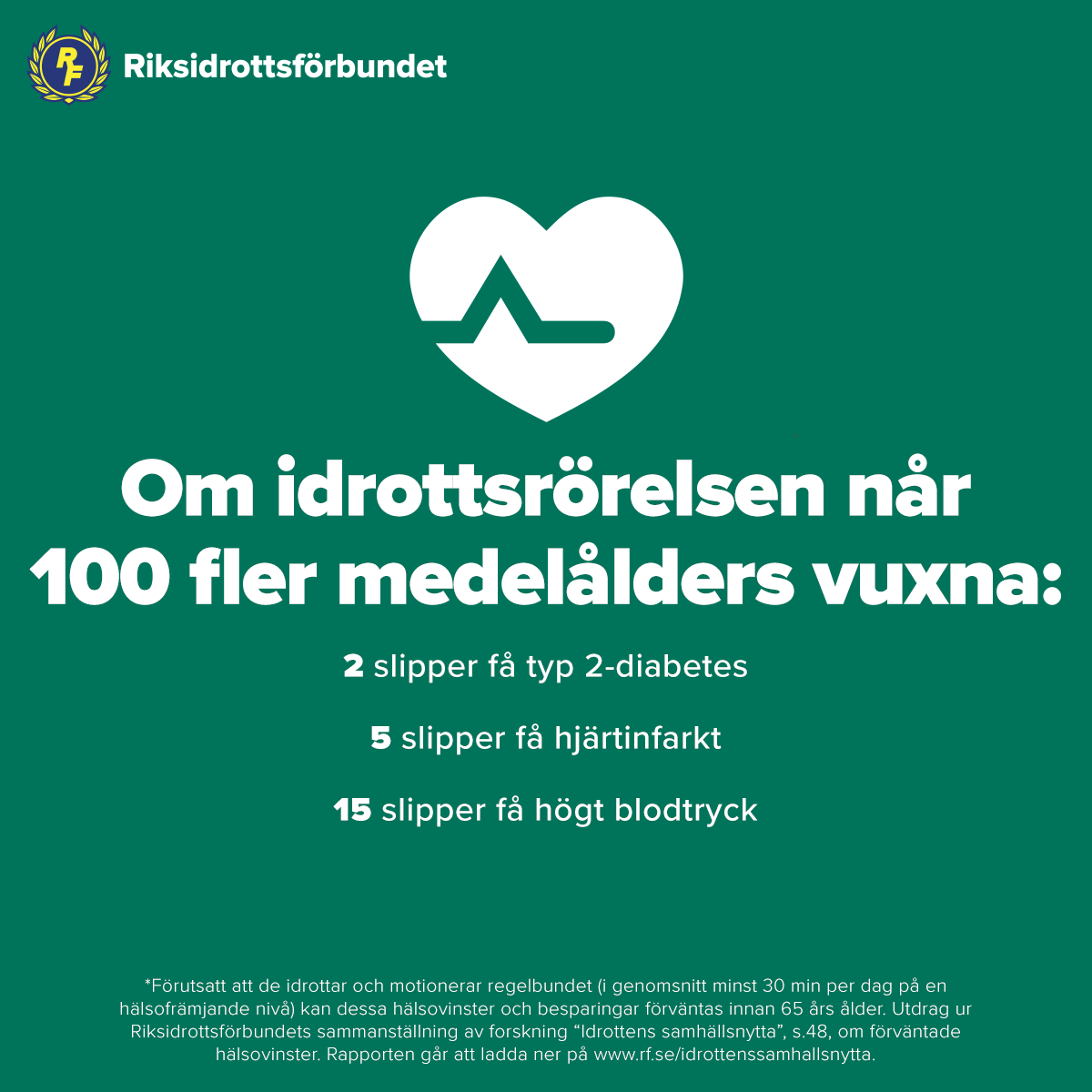
Låt oss ta ett exempel. Vad kan hända om 100 medelålders vuxna börja idrotta?
Jo, bättre hälsa som bryts ner enligt bilden.

Idrottens samhällsnytta Sportidealisten Lediga Sport Management Jobb Idrottsvetare Lediga SportJobb Lediga IdrottsJobb Sportkarriär Jobba med sport Sportutbildning idrottsutbildning SMART

Alltså ett specifikt mål med 100 vuxna och mätbart är att bland annat 2 kan slippa typ 2-diabetes. Accepterat/attraktivt innebär att de som planerar målet vill genomföra det och det gör Riksidrottsförbundet, eftersom de vill att alla ska idrotta. Är det ett realistiskt mål? Idrottsrörelsen har cirka 3.1 miljoner medlemmar, vilka kan vara ledare, utövare eller föräldrar som hjälper till i föreningslivet. Ja, utifrån resterande befolkning och med tanke på att det handlar om vuxna medelålders är det bara 100 stycken det handlar om. Plus att det innebär att 100 vuxna ska i genomsnitt träna 30 minuter per dag. Tidsbestämt för detta målet är att om ovan genomförs kan detta förväntas uppfyllas innan 65 års åldern för dessa medelålders vuxna.
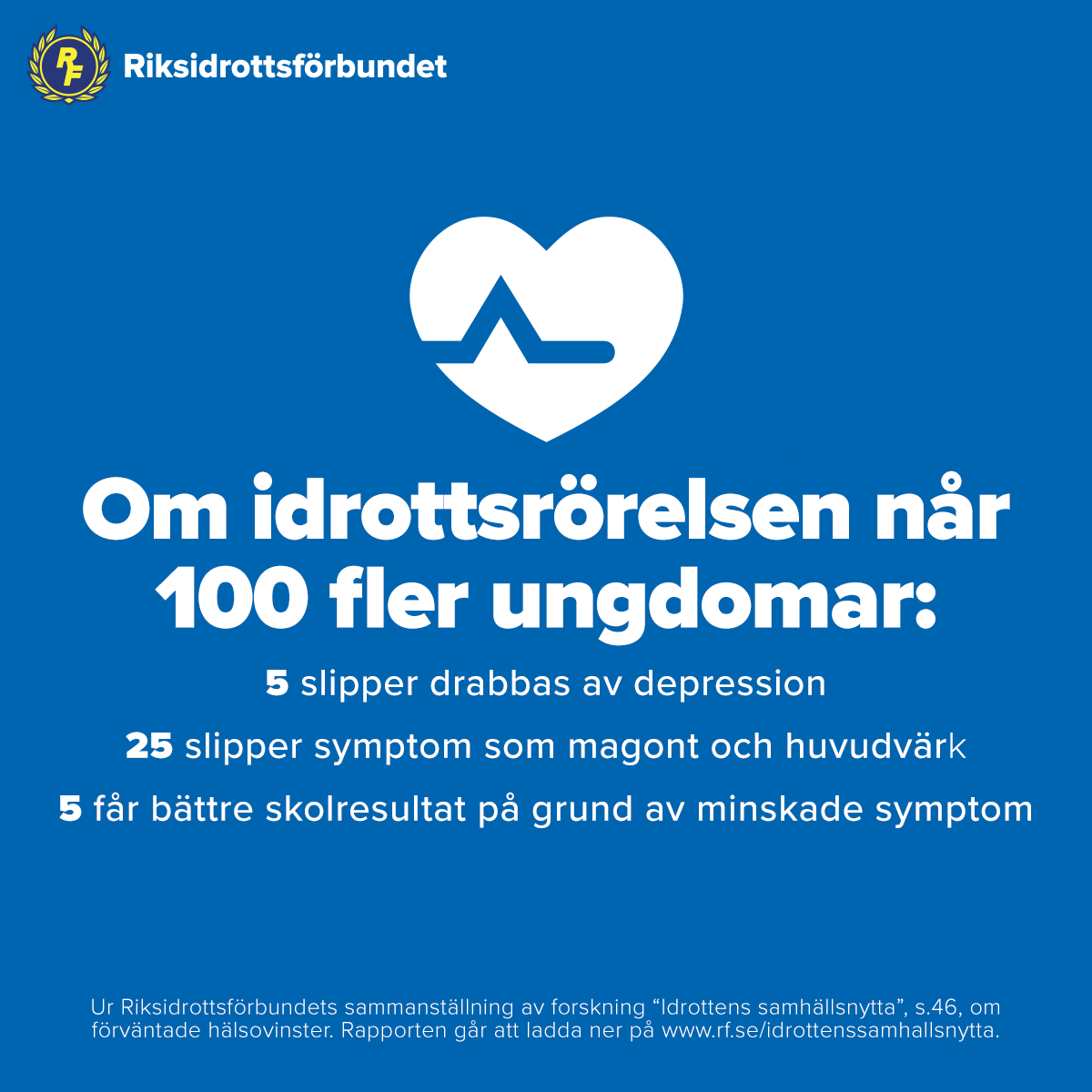
Idrott är inte bara för vuxna, utan även för barn och speciellt för den yngre populationen är idrott viktigt att associera med något positivt. Idrotten har goda effekter som bättre skolresultat och förbättrar den psykiska hälsan.

Idrottens samhällsnytta Sportidealisten Lediga Sport Management Jobb Idrottsvetare Lediga SportJobb Lediga IdrottsJobb Sportkarriär Jobba med sport Sportutbildning idrottsutbildning SMART

Sportidealistens lärdomar

Idrottsrörelsen har en stor roll i vårt samhälle. Under de senaste åren har dock rapporter handlat om ett minskat idrottsutövande bland barn och ungdomar. Vi vet att idrott är bra, fast det kan ofta upplevas som något självklart utan att vi verkligen förstår vad idrott kan bidra med. Vi måste bli bättre på att paketera och kommunicera ut vad idrottsrörelsen bidrar med till vår omgivning.
Idrottsföreningar runt om i landet gör väldigt mycket som hjälper samhället. En utmaning för idrotten är inte att aktivera barn och ungdomar, utan snarare att visa upp sig och visa att man existerar. Med dagens utveckling av det digitala samhället kan idrottslivet nå ut på ett helt annat sätt än förut. Sponsorer bör vara lättare än någonsin att hitta samarbeten med för att vem vill inte engagera sig med idrottslivet som kan minska på sjukvården och förbättra ungdomars framtid?

Vad detta inlägget har handlat om är helt enkelt att Riksidrottsförbundet har utvecklat sin kommunikation och börjat kommunicera om sina mål och idrotten på ett SMART sätt. Arbetar du i en idrottsförening kan det vara dags att inspireras av bilderna ovan och utmana sponsorer om de vill bidra till ett friskare samhälle. Eller varför inte utmana föräldrar som inte i dag har sina barn i idrottslivet.
När idrotten kommunicerar internt eller extern, försök göra det enkelt att förstå och att din idrott gör skillnad, fast beskriv hur den gör skillnad. Som exempelvis att varje vecka bidrar din idrott med x antal minuter fysisk aktivitet som förbättrar skolprestationer och psykisk hälsa.

Har du testat dessa knep? Har du ett eget förslag? Kommentera i kommentarsfältet under artikeln.

På återseende med mer lärdomar som ökar din kreativitet inom sportens värld.
Så skapar du förebilder och lika rättigheter i idrotten

så skapar du förebilder och lika rättigheter i idrotten

6 april 2019 är ett datum att minnas. Datumet då svensk damfotboll tog ett stort kliv. Sveriges damlandslag spelade en träningsmatch mot Tyskland och förlorade visserligen matchen på planen, fast på läktaren vann de våra hjärtan. 6 april 2019 är datumet då Sveriges damlandslag slog publikrekordet med cirka 5 500 åskådare från den senaste toppnoteringen med 20 302 åskådare 2002. Från och med nu är det 25 882 åskådare som är rekordet. I detta inlägget handlar det om hur vi skapar förebilder och hur vi skapar lika rättigheter för alla. Fast först kommer en video och en bild från det historiska ögonblicket den 6:e april i år.

https://www.instagram.com/p/Bv7F0VFgzZd/?utm_source=ig_web_copy_link
https://www.instagram.com/p/Bv6omyeJ7wq/

Se upp när pengarna styr

Från NY Times publicerades en artikel om Doncasters damlag som kanske var det framgångsrikaste damlaget i England under 80- och 90-talet. Doncaster har vunnit 6 F.A. cuptitlar och kom till final 11 av 12 gånger under en period under 80- och 90-talet. 2013 blev de nedflyttade från andraligan till tredjeligan när det engelska fotbollsförbundet (F.A.) valde att göra om andraligan mer professionellt. Det finns nu mer pengar än någonsin i damfotbollen och i detta fall i engelsk damfotboll. Förra året blev den högsta ligan helt professionellt, vilket innebär att alla spelare har en lön som inte kräver ett andra jobb.
Konsekvensen av nya TV-avtal och mer pengar in för den engelska damfotbollen var att F.A. satte högre krav på lagen i de högsta divisionerna. F.A. skapade nya kriterier för lag som spelar i andraligan gällande deras anläggningar, vilket Doncaster inte hade resurser till. I stället för att ge dem en förvarning eller hjälpa dem första året blev de nedflyttade och Manchester Citys nysatsade damlag tog Doncasters plats. Detta eftersom Manchester City som klubb har rika ägare som lagt in mycket investeringar i herrlaget och sedermera även damlaget. Manchester City hade resurserna att klara F.A.s kriterier, Doncaster hade inte ett herrlag att backa upp dem.

Vidare i artikeln kan man läsa att Doncaster kämpade sig tillbaka till den näst högsta ligan och senare vann den. Det skulle dock visa sig att de inte skulle ha råd att gå upp till högsta ligan. Återigen hade nya krav kommit till. Enligt F.A saknade de en huvudsponsor och ett herrlag som driver kubben ekonomiskt framåt. Samtidigt har Manchester United som är ett av världens största fotbollslag startat upp ett damlag som fick hoppa in direkt i näst högsta ligan 2018. Våren 2019 spelar Doncaster i tredje divisionen och håller på att åka ur, medan Manchester United spelar i näst högsta och håller på att gå upp till högsta och Manchester City är tvåa i högsta ligan.

Varför gör det engelska förbundet så? Kan anledningen vara att de skulle tjäna mer pengar från media om andraligans lag hade bättre faciliteter? Skulle förbundet tjäna mer pengar på en klubb som Manchester City och Manchester United än Doncaster? Kanske, är det så.

Jag undrar ibland för vem vi gör saker och ting, för. F.A. verkar ha glömt bort att Doncaster består av ett lag, fullt med spelare och ledare, som har kämpat i decennier. Medan Manchester City och nu senast Manchester United precis startat upp sin damfotboll och kliver rätt in i de högre ligorna. Vi måste se till att respektera varandra oavsett situation. Visst är det kul att den engelska fotbollen på damsidan har fått sin högsta liga fullt professionell och att ekonomin där blir starkare för varje år, fast kanske ska ett förbund ta beslut tillsammans med sina klubbar. Och varför ska det vara ett tvång på damsidan att ha ett herrlag om det inte är likadant krav för herrlagen med damlag?

Om inte detta låter konstigt så kan USAs läge gällande landslagsfotbollen var värt att notera. För nyligen stämde damlandslaget sitt eget förbund för könsdiskriminering. USAs damlandslag är mer framgångsrikt än USAs herrlandslag, fast ändå har de olika förutsättningar gällande lön. Om inte respektives förbund kan hjälpa till, vad kan vi vanliga göra då för att ge lika förutsättningar i idrotten?

En mer jämställd mediabevakning skapar fler förebilder?

Låt oss gå tillbaka till Sverige. Förra året utsågs SVT Sport till världens bästa sportTV-kanal. Dessutom är SVT Sport är en av aktörerna i sportens värld som arbetar för en jämställd sportbevakning. Under 2015 började de resan för detta arbete och då var det 25 % bevakning på damidrotten. När SVT Sport summerade 2018 har bevakningen via deras kanaler Sportnytt, Sportspegeln, svtsport.se och sociala medier gått upp till 44 %.

En stor utmaning som SVT Sport kämpar med är att öka mediabevakningen, särskilt för nivåerna under högsta serierna och eliten. Där är det betydligt mindre bilder och video från damidrotten. Där uppmanar SVT Sport sig själva och andra att fler täcker både herrar som damer på både elit-, som breddnivån.

Intressant nog har den klassiska synen på herridrottens stora skillnad till damidrottens om mer publik på läktaren för herrarna fått motbevis. SVT Sport skriver att de hade högre TV-tittarsiffror från Damallsvenskan när de sände den än när det har sänts matcher från herrarnas ishockeyserie SHL och engelska herrserien Premier League. De två sistnämnda har betydligt mer folk på arenorna i jämförelse med Damallsvenskan, fast Damallsvenskan gav bättre TV-tittarsiffror.

Damfotboll får mer uppmärksamhet

Samtidigt som 2019 är året då svensk damfotboll nått nytt publikrekord så växer intresset och möjligheten att se mer damfotboll i Sverige 2019. Damallsvenskan 2019 kommer sändas via SVT och Cmore, vilket ger fler möjligheten att se matcher från Sverige femte populäraste liga. Cmore har en målgrupp och SVT har en annan och därför ges en större bredd chansen att ta del av damfotboll och kunskapen om de bästa spelarna i ligan kan växa ytterligare. Ju mer vi vet, desto lättare att ha ett intresse.

Läser du detta mellan 8 och 14 april och befinner dig i närheten av Stockholm bör du åka till Stockholms Central där du får en unik möjlighet att ta del av livet som en ung tjejs fotbollsvardag.

Så skapas kvinnliga förebilder och engagemang

Vad kan du och jag göra för att bidra till en vardag som är lika för både pojkar och flickor, herrar och damer? Det europeiska fotbollförbundet, UEFA, har skapat ett dokument för att hjälpa fotbollen att växa på damsidan. Oavsett om du har en egen marknadsförare, en kommunikationschef eller att du arbetar i en mindre idrottsförening som vill börja marknadsföra mer av damfotbollen har UEFA skapat en kommunikationsguide till dig. Detta dokument ger dig kreativa idéer och praktiska tips som kan hjälpa dig att uppnå dina mål. Den är väldigt lätt att förstå och utformad för att enkelt kunna producera effektiva kommunikationskampanjer.

Här kan du ladda ner kommunikationsguiden för damfotbollen helt gratis.

Sportidealistens lärdomar

Idrott är inte bara roligt utan bidrar också till en lyckligare och friskare befolkning. Idrottsrörelsen är en stark samhällsaktör och spelar ekonomiskt och socialt en viktig roll i samhället. Idrotten är internationell med samma regler och förutsättningar oavsett språk och etnisk bakgrund.
När det kommer till damidrotten har den inte fått lika stor uppmärksamhet som herridrotten. Tänk dig att i dag växer pojkar och flickor upp med olika uppfattningar om vad som krävs och vilka möjligheter som finns att genomföra en elitidrottskarriär. Tänk vad viktigt det är med förebilder inom idrotten från både herrar och damer. Allt borde vara lika möjligt och då behöver vi ge lika förutsättningar.

  • Ett sätt att arbeta för lika rättigheter och förebilder är att media visar en jämställd sportbevakning.
  • Ett annat är att förbunden arbetar tillsammans med idrottarna.
  • Ett tredje är att idrotten själv ständigt arbetar med sin kommunikation, både internt och externt.

Att växa upp med idrott och fortsätta med det livet ut borde vara en självklarhet för både pojkar och flickor.

Vad tror du? Kan vi i Sverige skapa lika rättigheter och förebilder för alla? Kommentera i kommentarsfältet under artikeln.

På återseende med mer lärdomar som ökar din kreativitet inom sportens värld.

Svensk världsunik (hemlig?) sportteknologi

svensk världsunik (hemlig) sportteknologi

Tänk om du kunde flyga som en fågel? Ja tänk, fast det är inte bara en tanke, utan det är möjligt. I Sverige finns en vindtunnel som gör det möjligt att dels låta dig pröva att flyga som en fågel och dels är det guldgruvan för backhoppare och för att bli backhoppare. Sverige kanske inte har någon duktig backhoppare, just nu fast vi är världsledande med tekniken och teknologin. Mer om detta får du bättre koll på i detta inlägg.

Vad pratar jag om? Jo jag pratar om flygsport och den svenska guldgruvan för backhoppare, Indoor Wingsuit Stockholm (Inclined Labs AB). Allt började 2012 när Peter Georen och Anton Westman fick nys om LT 1 (Lågfartstunnel 1). Först handlade det om tanken att kunna ha en vindtunnel för att skapa Sveriges första vertikala vindtunnel och träna till exempel fallskärmshopp eller som du säkert sett många testa på idag, bodyflight. Fast även om detta inte blev av, så efter tre år dök nya idéer upp om LT 1, att flyga på riktigt, var det möjligt? 2016 blev det sedan ett faktum. Efter många tekniska utmaningar blev Georen den förste människan att flyga med vingdräkt i en lutande vindtunnel, och strax därefter blev Westman först med att flyga helt fritt, utan säkerhetssystem.

LT1, en topphemlig anläggning

Under 1930-talet skapades Flygtekniska Försöksanstalten och 1940 stod Låghastighetstunnel 1 klar med amerikansk hjälp. Anläggningen var topphemlig och blev en central anläggning för SAAB, försvarsmakten m. fl. som var inblandade i utvecklingen av svenska stridsflygplan. Denna anläggning har även varit en del av vår rymdhistoria, då den bidrog i skapandet av en rymdsond som åkte till Saturnus måne.

En unik upplevelse

Från att bygga om och åstadkomma en flygtunnel för flygsportsentusiaster, utvecklade dem ytterligare en unik upplevelse. De blev först i världen med att låta människan flyga fritt – inomhus och säkert. Det vill säga, från hösten 2018 erbjuds i dag vem som helst att åka till Bromma i Stockholm och testa på flygningen. När besökare flyger på Indoor Wingsuit Stockholm sker själva flygningen i ett glasrör kallat, The Flight Chamber.
Som de själva beskriver på hemsidan så skapades framtiden för flygsporten 2018:

Därmed förändrades framtiden för flygsporten. Gränserna för vad vi trodde var möjligt har flyttats. Tidigare begrepp ställs på ända.

Du kan flyga.

Kom och flyg.

Svenska guldgruvan

Vad har då allt detta att göra med backhoppning som tidigare nämnts? Jo, denna flygtunnel ger möjligheten för backhoppare att öva på sin balans som de tillämpar i alla sina prestationer när de åker utför backen och försöker hoppa så långt som möjligt. Vem har sagt att du måste ha en hoppbacke för att träna på hoppen?
Sverige har alltid varit i framkant när det gäller backhoppning. För du vet väl att det var en svensk som uppfann tekniken som alla använder i dag, V-stilen?

Från Skidförbundets hemsida: Tunneln sätter åter Sverige på backhoppningskartan. Genom åren har Sverige flera gånger legat i framkant när det gäller innovationer. Det var en svensk som föreslog att det skulle räknas distans och inte bara stil i poängräkningen, Jan Boklöv revolutionerade backhoppningen med sin V-stil på 1980-talet, vi var först i världen denna säsong med en snöbelagd backe och nu har vi även denna exklusiva vindtunnel. Det finns en mängd olika möjligheter till samarbeten med tunneln och vidare forskning för svensk backhoppning, säger Marit Stub Nybelius, kommunikatör för svensk backhoppning.

Inför vintersäsongen som snart är slut för vintersporterna kom det hela åtta landslag till LT 1 i Bromma, Stockholm. I följande video ser du Schweiz juniorlandslag testa på att flyga.
https://www.facebook.com/SwissSkijumpTeam/videos/264915250858870/

Eller varför inte se hur det ser ut med skidorna på?
https://www.facebook.com/skijumpingaustria/videos/252447585443352/

Från ett reportage av SVT berättar Österrikes landslag att det de kan göra på ett träningsläger i Bromma är vad som skulle ta två år i backen. De berättar även att de har kunnat träna på tekniken i tunneln som ger dem kanske två meter längre hopp i backen.

Från elit till bredd

I dag har de varit igång några år och de har både idrottare på plats för träning och allmänheten på plats. Deras vision är tydlig, de ska framåt och överallt. De vill bil det ledande bolaget i världen vad avser vindtunnelflygning i lutande vindtunnlar och driva utvecklingen av flygsport som helhet framåt. Ung som gammal kan flyga själv redan vid första försöket.
Grädden på moset är att de erbjuder en VR-upplevelse, vilket gör att du kan “flyga vart du vill”.

person skiing
Photo by Todd Trapani on Pexels.com

Sportidealistens lärdomar

I denna artikel har en unik teknik inte bara möjliggjort att vem som helst kan flyga, utan även att världseliten från backhoppning kommer till världens enda lutande vindtunnel. Nu kan två års träning utövas på en vecka för backhopparna.
I sporter där utförandet går på några sekunder men själva backen som med backhoppning tar tid, att ta sig tillbaka till startlinjen, är en flygtunnel en stor fördel. Inte bara att själva elitidrottarna kan snabbt kan göra ett nytt hopp och träna på balansen, utan även att deras tränare kan ge snabb feedback, samt kameror och andra tekniska utrustningar kan lättare appliceras på LT 1.
Sverige är återigen ett land i framkant vad det gäller backhoppning, innovation och teknologi. Framtiden ser ljus ut och ja, nu kan även du flyga.

Vad tror du? Kan vi i Sverige skapa fler innovationer som utvecklar idrotten? Vad vill du se utvecklas? Kommentera i kommentarsfältet under artikeln.

På återseende med mer lärdomar som ökar din kreativitet inom sportens värld.
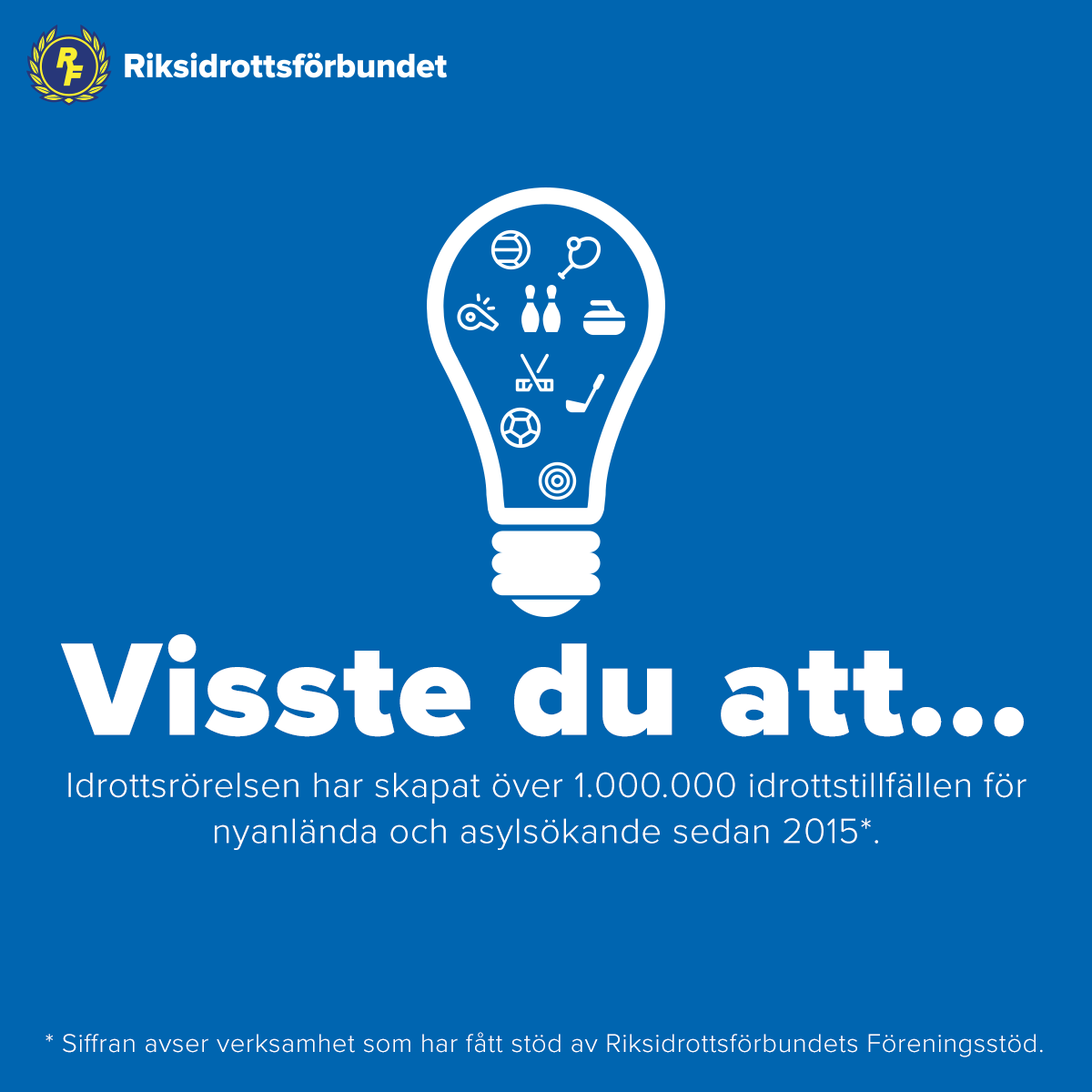
Två unika sätt att stärka relationen med fansen

två unika sätt att stärka relationen med fansen

Har du någonsin hört barn och ungdomar läsa upp matchens laguppställningar eller deltagare? Har du någonsin sett en match där en åskådare blir tränare? Dessa unika exempel kommer du få läsa om i detta inlägg.

Så skapar du lojala idrottsfans

Har du någonsin varit på en fotbollsmatch på Griffin Park? Det är en unik möjlighet att få se och höra klubbens unga fans läsa upp matchens laguppställningar. Via LinkedIn dök en video upp i flödet som handlade om en fotbollsmatch från just Griffin Park. Just detta inlägget engagerar eftersom det visar på bra innehåll.

This is one of things we do at Brentford Football Club for every home game. One home fan and one away fan reading the teams out just before kick-off. The only Clubs that I know that do this every week our ourselves and the good people at Motherwell Football Club. It costs absolutely nothing and really gets kids involved in your actual matchday. The only thing that stops others doing this is themselves.
— Ryan Murrant, Fan Engagement Manager, Brentford Football Club

Brentford FC, är en engelsk professionell fotbollsklubb i Brentford i västra London, grundad 1889. Sedan 1904 spelar de sina hemmamatcher på Griffin Park. Smeknamnet är The Bees. Klubben spelar sedan säsongen 2014/2015 i Championship. Källa: Wikipedia

Imponerande va? För att du ska få ta del av engagemanget från detta inlägg på LinkedIn,  kommer här några av kommentarerna om Brentfords video och funktion:

– This is brilliant, What a great way to get the kids involved, Good for confidence too…. Well done Brentford FC.
– First class idea which all team sports club should look at following. It cements a bond between the young fan and the club he/she has chosen to support and also helps with their personal development with the act of public speaking. Well done Brentford Football Club!

– Yes lots of clubs do one offs. I think it needs to be part of every Matchday. Adds value, costs nothing and you can change people’s perceptions. Started doing it when I was at Southend a few years ago, I wish more would do it.

– Very nice approach of fan engagement for home and away fans. I remember that we had interviews with home fans and also with fans from the competitor. Runs also fine but has to match club`s pholosophie.

– I do not follow football or any sport for that matter but this is brilliant. Something those kids will never forget. Show great showmanship between teams.

Ryan Murrant drog igång detta i en annan fotbollsklubb för fem år sedan och just i Brentford drog han igång det förra säsongen. För att få fram sina speakers använder de sig av Twitter, där alla som vill vara speaker får skriva en tweet med hashtag #BeeTheAnnouncer. Fast ibland väljer de bara ut två tycken ur publiken under matchdagen, vilket Ryan menar är magiskt.
Är detta allt? Nej då. Barnen får även bilder, de får möta sina favoritspelare om de är där. Det visade sig från kommentarerna att en annan engelsk fotbollsklubb gjort liknande och gjort så att barnen fick behålla sina laguppställningspapper. Dessutom kunde det ibland bli så att de fick dem signerade av spelarna. Men även att familjerna till barnen fick komma ner till planen för att ta bilder.

Så ökar du publiksiffrorna

Absolutely brilliant initiative from GAIS! Worlds first(?) ”Fanager” appointed!

Superettan-laget GAIS har också gjort något unikt. De lät ett av sina fans vara tränare, både i träningar och under en match. Varför gjorde GAIS detta? Jo, de hade en nedåtgående trend av sin biljettförsäljning. Tillsammans med Milk reklambyrå genomfördes en kampanj kallad, Tredjetränaren, för att vända på denna nedåtgående trend.

Kunde vem som helst bli tränare? Nej. Alla som hade ett säsongskort kunde söka rollen som Fanager (fan + manager = Fanager). Arbetsuppgifterna för rollen Fanager handlade om att vara tränare inför och under en match under säsongen 2018. Sebastian som fick rollen, skulle inte leda GAIS mot vilket lag som helst, utan mot Halmstad BK som under föregående säsong spelade i högsta serien. Detta ögonblick var historiskt! Det var första gången i världen ett fan blev tränare och tog klivet ner från läktaren till bänken.

-Det här är stort! Flickvänner kommer och går, men kärleken till familjen och GAIS består. De är en dröm att hjälpa GAIS till tre poäng, säger Sebastian Thörnqvist. — GAIS

Det blev ingen vinst (förlust med 2-1). Men frågan är om det var något Sebastian kunde gjort något åt. Däremot var själva kampanjen Fanager en intressant satsning. GAIS lyckades nämligen öka sin säsongskortsförsäljning med nästan 22 % och de fick global press och även utmärkelser för kampanjen.

Grymt kul att vår kampanj Tredjetränaren för GAIS inte bara ökade säsongskortsförsäljningen med 21.9 %, utan nu även sprids i marknadsföringskretsar. Se vår casefilm om världens första Fanager!
— Milk reklambyrå
Hurra! Idag blev vårt jobb för GAIS nominerat i SWEDMAs tävling Guldnyckeln. Tack juryn!
— Milk reklambyrå

Sportidealistens Lärdomar

Vad betyder fansen för en idrottsförening? Mycket! Det är fansen som är ambassadörer och sprider din idrott och ditt lag till andra. Det är fansen som stöttar laget framåt. Att bibehålla och stärka relationen med fansen så att de alltid förblir ditt lags fans behöver inte vara svårare eller mer kostsamt än att involvera de yngsta fansen från början. Se bara på hur Brentford FC har en magisk inramning på sina matcher, där de låter de yngsta fansen på arena att läsa upp matchens laguppställningar. Detta skapar inte bara minnen för sina yngsta fans, de låter även bortalagets fans läsa upp sitt lags laguppställning. Wow!

Ett annat sätt att bibehålla fans och stärka relationen med dem när det kommer till vuxna fans är att utse en Fanager. Speciellt när det kommer till säsongskortinnehavare. Det var så GAIS införde möjligheten för en av sina trogna fans som betalat biljetter för hela säsongen, att även vara med och träna sitt favoritlag under en vecka. Sebastian som fick äran lär också minnas tillbaka, liksom barnen hos Brentford, till ett minne som räcker livet ut. Dessutom ökades försäljningen av säsongskort för GAIS med 21.9 % med fanager-satsningen!
När du läser detta kan du stoltsera dig med att du har hört talas om två unika fall:

  1. Du har hört barn och ungdomar läsa upp matchens laguppställningar eller deltagare
  2. Du har även sett en match (ja i alla fall tagit del av en video) där en åskådare blir tränare för en vecka.

Avslutningsvis kan dessa unika exempel summeras med ett av Ryan Murrants svar:

 It doesn’t cost the club anything and the memories last a lifetime.

Vad tror du om dessa exempel? Har du egna erfarenheter? Dela med dig i kommentarsfältet nedan.

På återseende med mer lärdomar som ökar din kreativitet inom sportens värld.

22 Sports You’ve Probably Never Heard Of (and What They Are)

Many different sports in one image

Most people know football, basketball, and tennis — but sport is much bigger than the mainstream games we see on TV every day. Across the world, there are dozens of intriguing competitive sports that fly under the radar, mix unexpected elements, or are deeply rooted in local tradition.

Here’s a guide to 22 lesser-known or unusual sports — some are established competitive disciplines, others are regional curiosities — that might surprise you.

🥇 1. Alpine Luge

A winter sliding sport similar to traditional luge but performed on alpine tracks — a thrilling and technically demanding discipline.

🏂 2. Parallel Slalom Alpine Skiing

Racers go head-to-head on parallel courses, a fast-paced variation on classic alpine events.

🏸 3. Badminton

A fast racket sport played indoors or outdoors with a shuttlecock — hugely popular in Asia but less followed in some Western markets.

🎳 4. Bowling

Though familiar as a recreational activity, competitive bowling has professional leagues and world championships.

🥊 5. Wrestling

A classic combat sport with ancient roots and multiple styles, from freestyle to Greco-Roman.

🏎 6. Crosskart

A motorsport similar to karting but on dirt or gravel tracks using lightweight, high-power vehicles.

🚴‍♂️ 7. Cycle Trial

Cyclists navigate obstacle courses without putting their feet down — a test of balance and control.

💃 8. Dance Sport

Competitive ballroom and Latin dance — athletic, technical, and artistic in equal measure.

🐕 9. Dog Sled Racing

Teams of dogs pull a sled over snow-covered terrain — a historic mode of transport turned competitive sport.

💪 10. Tug of War

A classic team strength sport where two sides pull on a rope trying to drag the opponent across a line.

🏂 11. Big Air Freeskiing

Skiers perform aerial tricks over massive jumps — a mainstay in action sports competitions.

⛷ 12. Cross-Country Skiing

Endurance skiing over varied terrain — both recreational and highly competitive worldwide.

🏎 13. Radio-Controlled Car Racing

Precision, speed, and engineering come together as enthusiasts race small radio-controlled vehicles.

🚗 14. Rallycross & Rallysprint

High-speed motorsport on mixed surfaces — dirt, gravel, and tarmac.

🏉 15. Wheelchair Rugby

A fast-paced Paralympic team sport combining elements of rugby and basketball.

🏁 16. Skicross

Skiers race simultaneously down a course with jumps and turns — thrilling mass-start action.

🛷 17. Snowboard Big Air

Riders launch off huge ramps to perform tricks — a favorite in winter X-games.

🥎 18. Softball

A cousin of baseball with faster pitching and smaller fields — hugely popular across the Americas and Asia.

🏍 19. Snowmobile Stadium Cross

High-speed snowmobile racing on stadium tracks — an adrenaline-packed winter spectacle.

🏋️‍♂️ 20. Team Powerlifting

Strength athletes compete in lifts — squat, bench press, and deadlift — often as part of a team format.

🎮 21. Virtual Motorsport

A growing competitive arena where gamers race in realistic simulators — featured recently at SM-veckan.

🏍 22. X-Trial

Motorcycle trials focus on precision and balance as riders tackle artificial and natural obstacles without touching the ground with their feet.

🧠 Why These Sports Matter

These disciplines show just how diverse the world of competition can be — from team strength contests to precision riding, action sports, and technical athletic events. Many have rich cultural histories, dedicated followings, and pathways to elite competition even if they don’t get mainstream media coverage.

Unusual sports challenge our assumptions about what sport even means — and often create communities just as passionate as traditional games like football or basketball.

Want to Learn More?

If this list sparked your curiosity, here are a few other lesser-known sports worth exploring around the world (great for research, travel, or inspiration):

Other articles at Sportidealisten you want to read:

Sex tips till en god stämning

sex tips till en god stämning

Vanligtvis när det kommer till framgångsrika sportevenemang, oavsett om det är en turnering, uppvisning eller tävlingsmatch bedöms de efter bra prestationer på plan, en engagerande publik och media. I följande inlägg ges sex olika tips för hur du kan skapa den engagerande och goda stämningen. Kickstarta redan idag!

  1. Luleå Hockey med publikrekord

  2. Gör inte som andra, gör som MLS

  3. Använd Instagram på bästa sätt

  4. Visa upp vad dina åskådare kan missa

  5.  Digital content med spelschema

  6.  Bakom kulisserna med unikt innehåll

1. Luleå Hockey med publikrekord

“En bild säger mer än tusen ord”, ett klassiskt citat som verkligen passar bra för denna tweet.

Damernas ishockeyelit har helt andra förutsättningar med resurser än herrarna. Bland annat media kan hjälpa till att locka folk till matcher. Trots att det är en stor skillnad mellan damernas ishockeyliga (SDHL) och herrarnas ishockeyliga (SHL) är det få ishockeyklubbar som lyckats så väl att lyfta fram båda sina elitlag som Luleå Hockey.

Under hösten fick Luleås ishockeyklubb kvittot på deras arbete med både herrlaget som med damlaget. #Rekordmatchen som det hänvisas till i tweeten ovan visar en fantastisk inramning av en fylld arena. Att Luleå Hockey dessutom uppmärksammar en tacksamhet till alla som bidragit till denna rekordmatch gör det bara än mer viktigt att belysa denna förening.

2. Gör inte som andra, gör som MLS

Amerikansk sport brukar vara förknippad med mer underhållning än en speciell supporterkultur. När det kommer till de stora sporterna i USA: basket, amerikansk fotboll, baseboll och ishockey så brukar vi i Europa ta efter hur de organiserar dels sporten och dels hur fansen är. Fast fotbollen, alltså “soccer” som amerikanare kallar den, har växt ordentligt de senaste åren.

Den europeiska fotbollskulturen är ofta förknippad med läktarkultur av att sjunga olika sånger och heja fram sitt lag. I jämförelse med den amerikanska underhållningskulturen kan det bli svårt att antingen övertyga resterande fotbollsvärlden med en fotbollsmatch, där fansen underhålls istället för underhåller fotbollslagen. Vice versa gäller att övertyga amerikanarna om hur läktarkulturen är från Europa.  Här finns en liten krock gällande hur den kan växa och utmana den europeiska fotbollskulturen som är dominerande i fotbollsvärlden.

Fotbollsligan i USA heter Major League Soccer (MLS) och de försöker lyfta fram MLS som den bästa sporten och ligan i USA och även i världen. Fast hur kan de göra det när inte de bästa spelarna går dit? MLS är en rätt så ny fotbollsliga i jämförelse med de andra fotbollsligorna i världen och har därför inte samma status som de övriga ligorna. Ett sätt för att MLS ska locka till sig intresse är att ständigt tänka kreativt och prova olika tillvägagångssätt att få uppmärksamhet och engagera nya fans. Som till exempel låta en fotbollsspelare bära på en mikrofon och prata med kommentatorerna under en fotbollsmatch.

“America just DOESNT understand FOOTBALL”
“I liked seeing this from an educational standpoint. Gives young players useful information as to what they should be communicating to their center backs during the game”.

Dessa två kommentarer är bara en liten del av alla som finns till videon av denna mikrofonsituationen. Den första är helt klart baserat av den europeiska fotbollssynen medan den andra kommentarer tänker ur ett utbildningsperspektiv. Visst kan det kännas konstigt att störa en fotbollsspelare, fast det ska sägas att detta exempel är bara genomfört i en träningsmatch.

Gary Stevenson, president and managing director, MLS Business Ventures: “It is a very American thing to do but this idea of giving fans an inside look at is what is going on, we like that a lot.”

3. Använd Instagram

I genomsnitt spenderar Instagramanvändare 53 minuter per dag, vilket är bara fem minuter mindre än Facebookanvändare, fast fyra minuter mer än Snapchatanvändare. Det ska dock sägas att denna data är främst via androidanvändare. Denna data är intressant på så vis att det är en plattform som är populär och Instagram har en stor potential att nå ut till sina nuvarande och potentiella intressenter. Här kan du läsa om sex tips för att skapa engagerande innehåll på Instagram och kanske öka antalet följare, fast framförallt mer lojala följare och öka ditt varumärke.

1) Panoramic

2) Split Screen Voting

3) Use Color Matching

4) Get Creative With Your IG Fonts
5) Get Tapping

6) Hide Links In Your Stories

Ett av dessa jag vill ta upp här som även fotbollslaget Chelsea FC har tillämpat är 5) Get Tapping. Detta gäller för dig som redan använder Instagram Stories eller funderar hur du ska använda det. Fördelen med de exempel som ges här från Chelsea är att denna strategi engagerar många fans. Enligt Delmondos undersökning upptäckte de att mer än 70 % av de som tittar på dina Instagram Stories klickar igenom dem relativt fort. De menar att eftersom detta är en fysiskt interaktion så ta det till din fördel och engagera följarna med ett intressant innehåll.

Chelsea FC Instagram tips Sportidealisten Sport Management Idrottsvetare SportJobb IdrottsJobb

Chelsea FC Instagram tips Sportidealisten Sport Management Idrottsvetare SportJobb IdrottsJobb

4. Visa upp vad du kan missa (LA FC Twitter)

Har du någonsin hört talas om en hörnflaggscamera kontrollerad av folket? Det är något som Los Angeles FC tagit fram i samarbete med Twitter. Det är helt enkelt du eller jag som har ett twitterkonto som kan styra vad vi vill se i en match. I exemplet nedan kan du se hur det såg ut när detta prövades i ena Los Angeles derbyt under 2018.

Från en artikel från SportTechie beskrivs funktion:
“Every time someone tweets with the hashtag #LALookIn, the on-site DSLR camera will snap a photo that will then be sent to the user in a reply. Nearby corner kicks will offer compelling close-ups. If a player scores, maybe he will return to mug the camera as part of his goal celebration”.

5. Digital content med spelschema

Ett annat intressant exempel från 2018 är från den amerikanska basketligan NBA. När spelschemat för årets säsong publicerades var det flera basketlag som själva publicerade sina första matcher eller när deras svåraste matcher kommer bli av på hemmaplan. Fast flera av basketlagen gjorde om detta enkla budskap till ett kul, engagerande och spännande meddelande. Jag själv blev mer intresserad att gå på några matcher och några av basketlagens publicerade budskap/meddelanden som nådde mig kommer här.

Sacramento Kings med filmkopplingar

Golden State, lite av allt möjligt, dels spelarna själva och dels spellistor kopplat till motstånd och mycket mer.

Charlotte Hornets

Kul koncept med spelarkort där varje kort de presenterar visar vilka datum de möter respektive motståndare. Eftersom de använder korten som är lite retro kan flera av bilderna på korten vara bilder från förr i tiden med gamla klassiska spelare, vilket kan skapa lite nostalgi och väcka lite goda minnen från förr.

6. Bakom kulisserna med unikt innehåll FCK och Man C

Att visa upp hur atleter och klubbar arbetar bakom kulisserna har blivit lättare att ta del av under de senaste åren med hjälp av sociala medier. Något annat som dykt upp på sistone är dokumentärer och tv-serier via diverse digitala plattformar så som Amazon, YouTube och Netflix.
I ett av de senaste blogginläggen här på Sportidealisten har du fått ta del av när FC Köpenhamn gjort en dokumentärserie via YouTube om svenska fotbollsspelaren Erik Johansson (spelar numera i Djurgårdens IF). Utöver denna har Juventus lanserat sin en egen serie som lanserades via Netflix. Dessutom lanserade Manchester City tillsammans med Amazon sin dokumentärserie som dessutom går att se på Netflix.
I alla dessa ges väldigt mycket insyn i hur klubbarna och atleterna arbetar på plan och vid sidan av planen. De visar även upp hur det fungerat på sportkontoren och diverse möte, vilket kanske inte säger allt om hur de arbetar vid strategiska beslut, fast det finns mycket som sällan visas via vanliga nyhetsmedia.

Avslutningsvis, så är det väldigt svårt att få reda på hur det fungerar med damidrottare. Varför finns det inte liknande dokumentärer och serier som med manliga lag och atleter? Det finns dock en video som kan ge mer insyn hur en fotbollsspelare upplever sin vardag, vilket du kan se nedan.

Sportidealistens Lärdomar

Sex olika perspektiv har lyfts fram. Allt från rekordpublik, till engagerande innehåll via sociala medier och till bakom kulisserna. Tillsammans visar de olika tillvägagångssätt som kan öka stämningen på och utanför arenan.
Om det är något jag vill dra som slutsats från 2018 års höjdpunkter är det att bra prestationer på plan, en engagerande publik och media tillsammans kan skapa en bättre idrottsupplevelse. Detta gäller både för idrottarna själva, som för åskådarna och media. Dessutom finns det en brist på bakom kulisserna från damidrottare och damlag inom idrotten. Troligtvis skulle fler dokumentärer och TV serier kunna öka kunskapen om kvinnornas roll i idrottens värld och kan bidra till en mer jämställd idrottsvärld. Ensam är sällan starkast.
På återseende med mer lärdomar som ökar din kreativitet inom sportens värld.